
How Different Streamlined Admissions Models Shape the Student Experience
Published May 20, 2026
Across the country, states, systems, and institutions are rethinking what it means to open the door to college opportunity. To simplify the admissions process and encourage enrollment, many are turning to streamlined admissions models. These models vary in design but aim to reduce friction in the typical admissions process, which many students describe as complex and stressful. As momentum builds to rethink admissions processes, it is essential to determine which approaches are most effective and for whom. That starts with a clear and student-centered understanding of each model.
Key design features of streamlined admissions models can differ substantially. Table 1 situates the standard admissions process and three streamlined models—direct, informed, and guaranteed—on a spectrum of complexity. Across each model, the steps to apply are similar. What differs is the order in which each step occurs, the level of effort required of students, and the degree of certainty students have about their admission throughout the process.
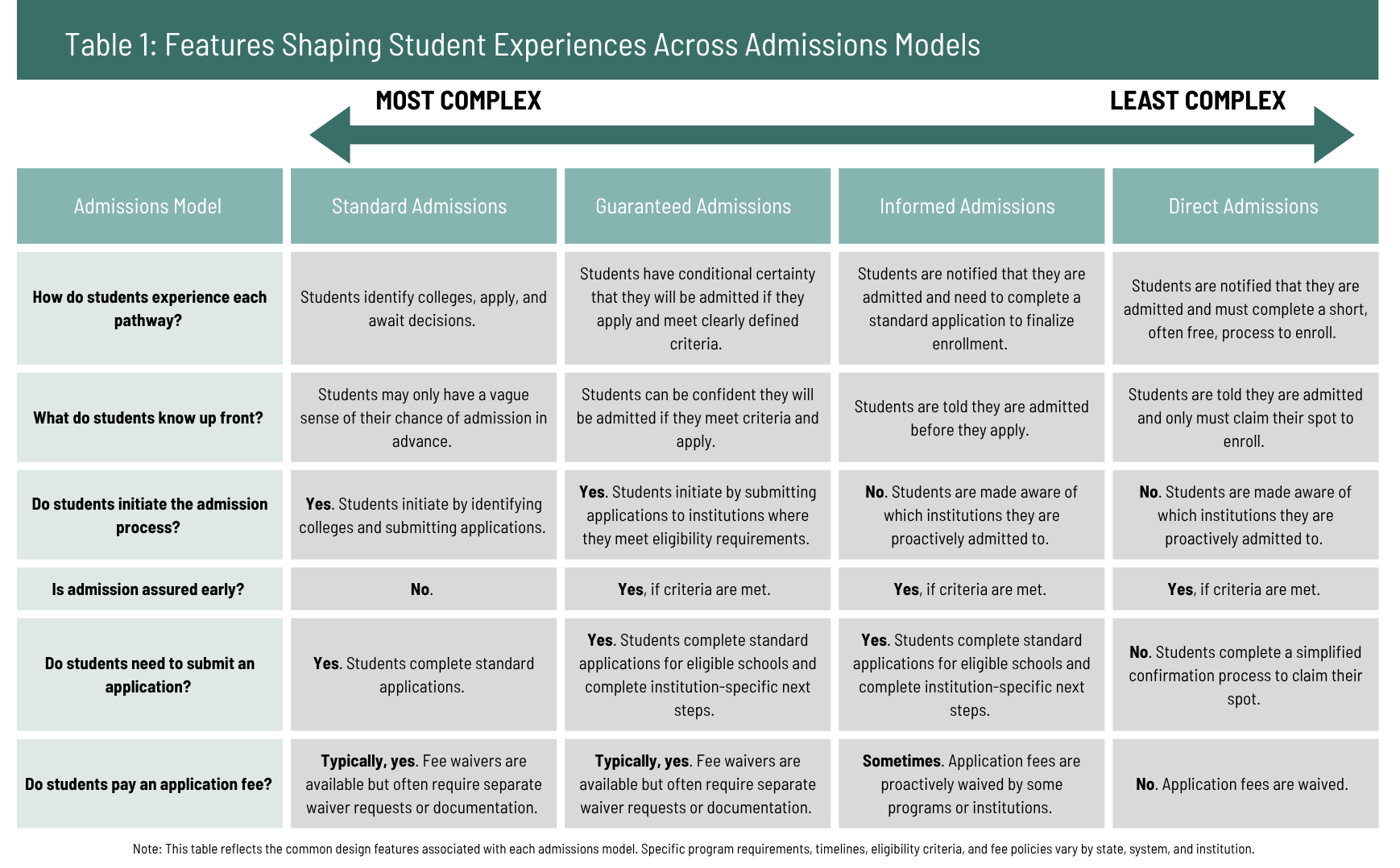
At one end, the standard admissions model requires students to complete all application steps before receiving a decision, with limited certainty along the way. At the other end, direct admissions models proactively notify students of admissions decisions and minimize the effort required from students to enroll. More than a dozen states now operate direct admissions programs that admit students based on set criteria and existing academic records, without requiring an application. Other streamlined models like guaranteed admissions and informed admissions similarly aim to reduce barriers in slightly different ways. In guaranteed admissions models, students must complete a standard application but can be confident of admission to an institution if established criteria are met. In informed models, it is communicated to students that they’re admitted and will be accepted if they apply.
Streamlining the admissions process can expand college access by reducing administrative barriers for students. About one-quarter of students who demonstrate interest in applying leave their applications unfinished. Among those students, Black, Hispanic, rural, and students from low-income backgrounds are disproportionately represented, underscoring how process complexity can reinforce inequities. While states, systems, and institutions may face constraints such as limited data infrastructure, lack of cross-agency coordination, or varying institutional capacity to participate in direct admissions models, even incremental steps can make a difference. Proactively communicating eligibility or eliminating application fees can serve as practical progress toward creating a less complex process.
What’s Next for Streamlined Admissions
Early evaluations find that direct admissions programs increase application rates, particularly among students from historically underrepresented racial and ethnic groups, first-generation students, and students from low-income backgrounds. But research on the impact of direct admissions models on enrollment is mixed. Some studies show modest enrollment increases, while others indicate that additional student supports—such as proactive advising or clearer financial aid information—are necessary to meaningfully shift enrollment patterns. Texas’ Top 10 Percent Rule, a guaranteed admissions program which assures admission to top high school graduates, for example, is associated with increased enrollment of students from under-resourced high schools at the state’s public flagships.
Differences in program design can lead to measurable differences in student outcomes. First-dollar free college programs, for example, increase affordability and have a substantially greater impact on postsecondary value than those designed as last-dollar programs. More research is needed to fully understand how different streamlined admissions models and design choices within those models impact students’ college access. Rigorous research on the Tennessee Direct Admissions program that pairs proactive admissions with early signals of financial aid, for example, will offer nuanced insights into how program design shapes students’ decisions and outcomes.
Admissions complexity can be a barrier to college access. But states, systems, and institutions can address these challenges and simplify the process for students. As streamlined admissions models evolve, ongoing evaluation will be critical to understanding which design features are most effective and for whom, as well as where additional supports or innovations are needed. By centering the student experience in admissions design, institutions and states can move closer to a system that opens the door to college and helps more students walk through.