What Does College Selectivity Look Like Where Most Students Enroll?
Published May 20, 2026
Public dialogue about college admissions often spotlights a small group of highly selective private colleges, creating a distorted picture of the broader higher education landscape.
Survey data show students tend to overestimate how hard it is to get into college, and, as a result, many don’t apply to their top-choice colleges because they anticipate rejection. In reality, most selective colleges admit the majority of their applicants. Among four-year colleges that use a selective admissions process, 85 percent admit at least half of their applicants and many admit far more.
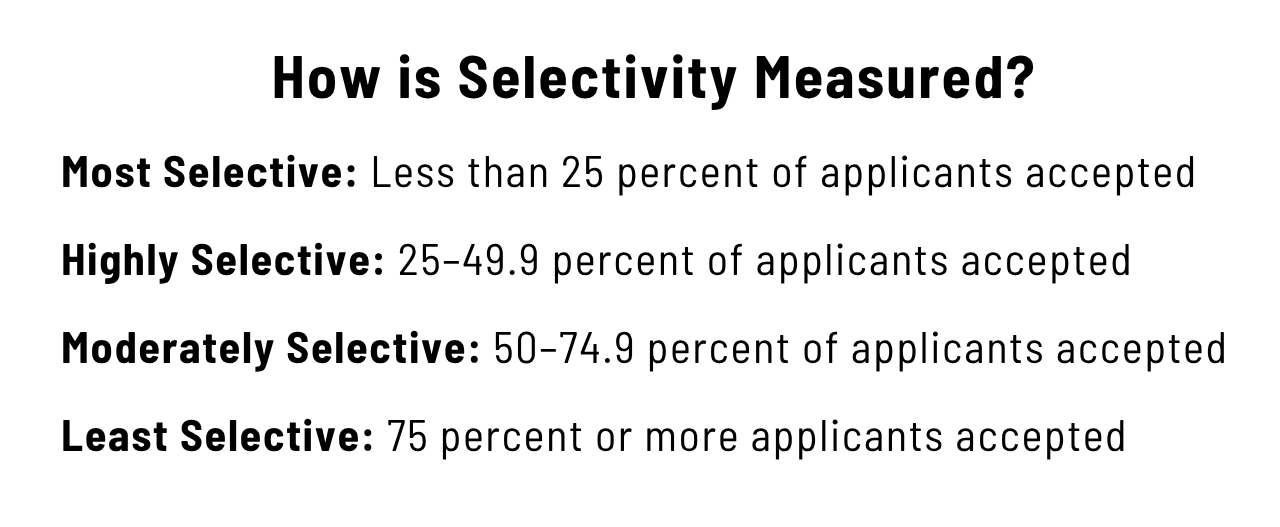
Our new analysis of 2024 Integrated Postsecondary Education Data System (IPEDS) data reveals substantial variation in selectivity among different types of four-year or above colleges with a selective admissions process. We define a “selective” institution as any college that does not admit all applicants, ranging from those that admit nearly all applicants (Least Selective) to those that admit only a small fraction (Most Selective). Approximately 1,700 public four-year or above institutions nationwide use selective admissions and stand to benefit from reimagining those policies.
The data also show that admissions practices known to introduce inequitable outcomes, such as legacy admissions and letters of recommendation, remain widespread, even among Least Selective colleges. These practices, originally developed to restrictcollege enrollment to White, wealthy, and Protestant students, continue to shape who enrolls and where. Examining these differences provides insight into how admissions practices can either reinforce or reduce inequities, and can guide policy changes that expand students’ access to degrees and career advancement.
Most Four-Year Colleges with Selective Admissions Admit the Majority of Applicants, But Private Nonprofits Are More Selective
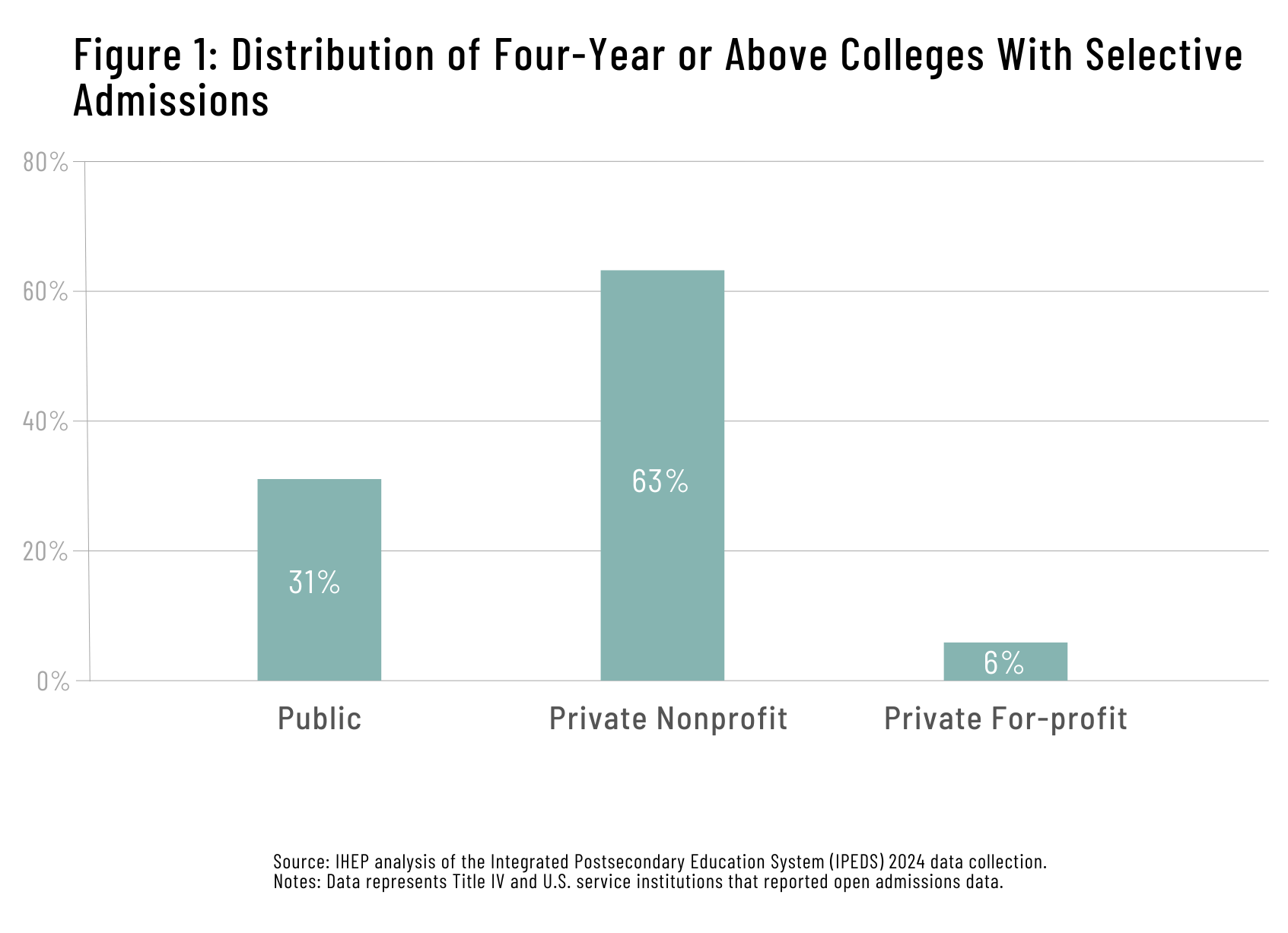
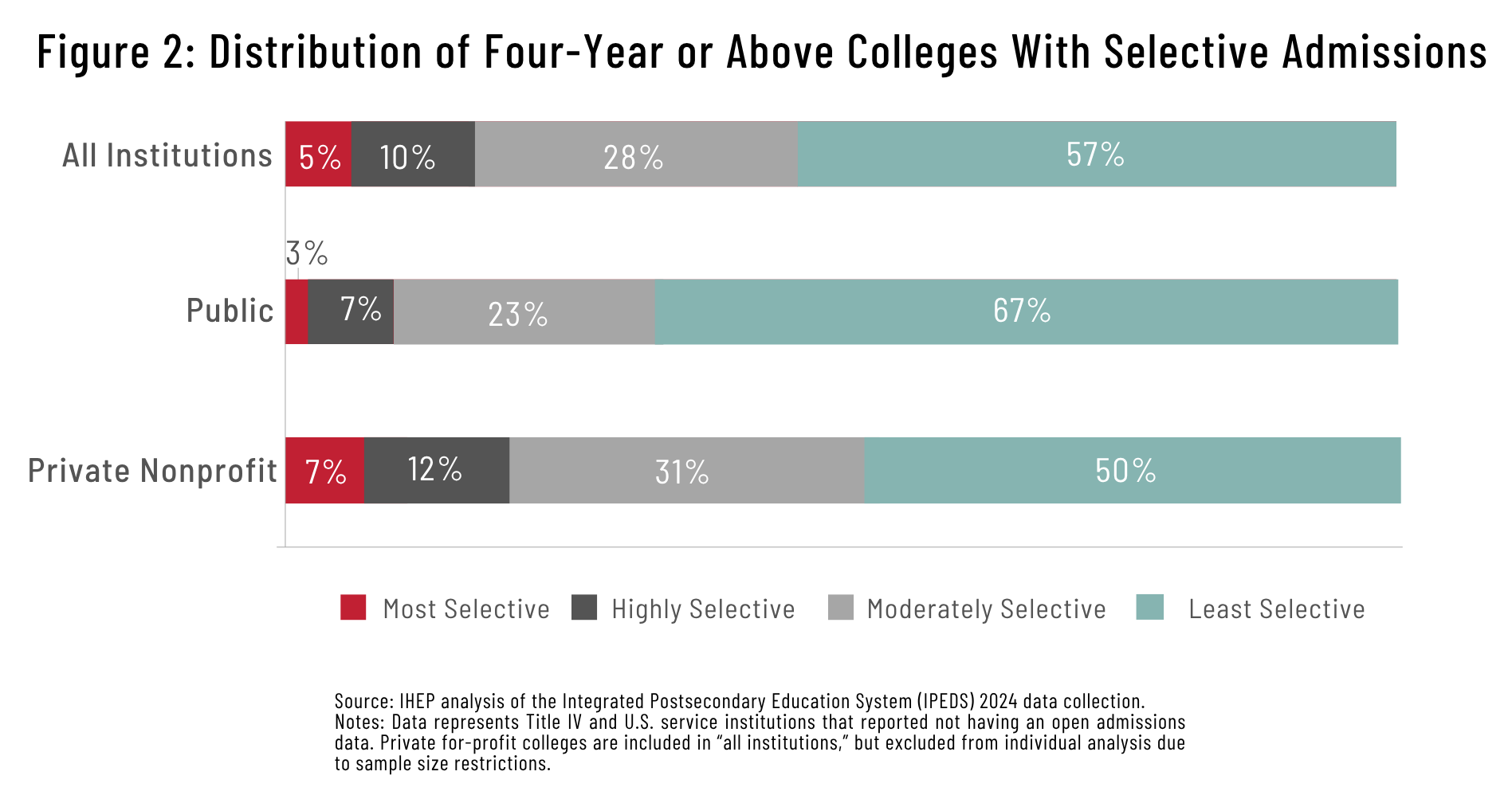
About twice as many private nonprofit colleges use selective admissions as public colleges. Yet contrary to popular perception, most selective colleges admit a large share of students: 57 percent accept at least three in four applicants, and 85 percent admit at least half.
Private nonprofit colleges, however, tend to be more selective than their public counterparts. Nearly seven in ten public colleges fall into the Least Selective category, compared with half of private nonprofits
Selective colleges enroll approximately 11.4 million students and about 66 percent of those students attend public institutions. Reforming admissions practices at these institutions can expand opportunity for students who face the greatest barriers to higher education, including many Black, Latinx, Indigenous, and underrepresented Asian American and Pacific Islander, first-generation students, and students from low-income backgrounds. Public colleges have a particular responsibility to examine exclusionary practices within their admissions processes given their mission to serve as pathways to economic mobility for state residents.
Harmful Admissions Practices Are Prevalent Even at Less Selective Colleges
Admissions practices such as legacy admissions and letters of recommendation were designed to preserve privilege at the nation’s oldest institutions. They remain common across the higher education landscape, including at colleges with high acceptance rates. Nearly one in four Least Selective colleges consider legacy status in admissions decisions. Legacy preferences continue to advantage applicants from affluent, college-educated families and are associated with lower enrollment of Black and Latinx students, and students from low-income backgrounds who have historically faced persistent barriers to higher education access.
The use of legacy preferences increases with selectivity, with variations by institution type. At Least Selective and Moderately Selective colleges, private nonprofit colleges consider legacy at nearly three times the rate of public colleges.
Figure 3: Prevalence of Legacy Consideration in Four-Year College Admissions, by Selectivity and Institution Type
Considered if submitted
Source: IHEP analysis of the Integrated Postsecondary Education Data System (IPEDS) 2024 data collection.
Notes: Data represent Title IV and U.S. service institutions that reported not having an open-access admissions policy. Legacy consideration reflects whether institutions consider legacy status if it is submitted as part of the admissions process. Private-for-profit colleges are included in “all institutions,” but excluded from individual analysis due to sample size restrictions. Asterisked values should be interpreted with caution, as they are based on samples of 10 or fewer institutions.
Letters of recommendation are even more prevalent in admissions decisions, which can penalize students from under-resourced schools whose counselors have higher caseloads and limited time to write detailed letters. Research shows first-generation students and students who receive fee waivers receive letters with fewer sentences highlighting key strengths—such as intellectual promise, academic achievement, and extracurricular involvement—even among students with similarly strong academic credentials. Among Black and Latinx students with similarly strong academic credentials, letters are also shorter, but the differences appear primarily in descriptions of extracurricular activities, such as arts and athletics.
These letters are required or considered at 67 percent of Least Selective colleges and 62 percent of Moderately Selective colleges, rising to 92 percent at the Most Selective institutions. Public colleges are less likely to use them. Approximately eight in 10 private nonprofits in the Least Selective and Moderately Selective categories require or consider letters of recommendation, compared to between 43 and 50 percent of publics.
Figure 4: Use of Letters of Recommendation in Four-Year College Admissions, by Selectivity and Institutional Type
Required
Considered if submitted
Source: IHEP analysis of the Integrated Postsecondary Education System (IPEDS) 2024 data collection.
Notes: Data represents Title IV and U.S. service institutions that reported not having an open access policy. Private-for-profit colleges are included in "all institutions," but excluded from individual analysis due to sample size restrictions. Asterisked values should be interpreted with caution, as they are based on samples of 10 or fewer institutions.
These patterns suggest that even institutions that admit most applicants rely on outdated or inequitable admissions criteria. At private nonprofits, higher use of legacy and recommendation requirements may reflect a continued emphasis on prestige and donor relationships, while public colleges face greater accountability from state legislators and the public to prioritize broad access.
Reenvisioning College Selectivity Through Admissions Reform
Reenvisioning college selectivity means shifting focus away from prestige toward access. Federal, state, and institutional policymakers should advance admissions reform across all colleges, with particular attention to the institutions where most students are enrolled.
Several states—California, Colorado, Illinois, Maryland, and Virginia—have already banned legacy admissions policies, contributing to an all-time low in their use. At the federal level, legislative proposals such as the Fair College Admissions for Students Act (S.880) would extend this progress nationwide.
Institutional leaders also have a responsibility to evaluate what admissions policies introduce bias and barriers to admission and enrollment for students. One bright spot is the University of California, Los Angeles. The university does not require letters of recommendation because they disadvantage students from under-resourced schools. Where letters remain a part of the process, admissions staff should be trained to assess them within the context of structural inequities that shape how they are written.
Reforming admissions practices across all types of colleges, selective or not, will help ensure that every student, regardless of race, income, or background, has a fair chance to pursue a degree and the opportunities that come with earning a college education.
 Our new analysis of 2024 Integrated Postsecondary Education Data System (IPEDS) data reveals substantial variation in selectivity among different types of four-year or above colleges with a selective admissions process. We define a “selective” institution as any college that does not admit all applicants, ranging from those that admit nearly all applicants (Least Selective) to those that admit only a small fraction (Most Selective). Approximately 1,700 public four-year or above institutions nationwide use selective admissions and stand to benefit from reimagining those policies.