New IHEP Resource Quantifies Economic Value of Public Four-Year Degrees in All 50 States
Published Jul 09, 2026
Interactive tool shows how state and federal policies can increase the economic value generated by four-year public colleges to students and communities
WASHINGTON, DC (July 9, 2026) — The Institute for Higher Education Policy (IHEP) today released its Economic Value Simulator, a new interactive resource showing that young adults who earned bachelor’s degrees from public four-year colleges generate approximately $140 billion in additional annual income nationally, after accounting for college costs. Using the Postsecondary Value Commission‘s framework, the resource measures the Economic Value Contribution (EVC) generated by public four-year colleges in every state and identifies policy changes that could further strengthen higher education’s contribution to state and national economies.
Policymakers and institutions nationwide are working to equip individuals for workforce readiness and build more resilient state economies. The Economic Value Simulator can inform those efforts by providing state-specific estimates of the economic returns of public higher education and highlights how improvements in affordability, college completion, and workforce outcomes could increase those returns for students, states, and the nation.
“Higher education generates substantial economic value for students, employers, and communities across the country, but the magnitude of that value is shaped by policy choices,” said Erin Dunlop Velez, IHEP Vice President of Research. “The Economic Value Simulator gives policymakers and institutional leaders a way to see how investments in affordability, college completion, and workforce outcomes can increase those returns. We hope it inspires decision-makers to prioritize policies that strengthen higher education’s economic value for students, states, and the nation.”
The EVC calculation measures the annual increased earnings for residents of each state, due to the public four-year institutions in that state. Rather than focusing solely on earnings, the figure captures the economic benefits associated with a bachelor’s degree, the out-of-pocket costs students pay for that degree, and the number of students who successfully realize those benefits.
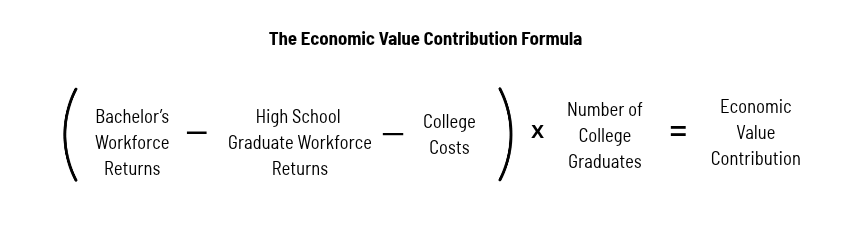
By framing value this way, the tool simulates exactly how targeted state and federal interventions alter these economic returns.
On a national scale, adjusting just one part of the formula yields massive dividends:
- Lowering College Costs: Policymakers in partnership with institutional leaders, could increase the national EVC to $153.4 billion annually by expanding need-based financial aid and reducing annualized college costs, including tuition and fees, by 10 percent, easing the financial burden on students.
- Boosting Graduation Rates: Policymakers and institutional leaders could invest in student success initiatives that increase college completion rates. Increasing bachelor’s degree completion at public universities by 10 percent would expand the pool of college-educated workers and boost the national EVC to $154 billion annually.
- Improving Workforce Returns: Policymakers and institutional leaders could increase the national EVC to $204.1 billion annually by strengthening the college-to-career pipeline so graduates can translate their credentials into strong high-quality careers paths that yield a 10 percent increase in median earnings.
At the state level, the simulator highlights localized paths to growth, illustrating how state policy changes dictate economic outcomes:
- California: Currently, public college graduates ages 25–34 generate $27.7 billion in additional annual income. If state policymakers and institutions reduce college costs by 10 percent, that change unlocks an additional $2.3 billion for the state economy every year.
- Texas: Increasing graduation rates by 10 percent in Texas would increase the state’s economic value contribution by $1.9 billion.
- Ohio: If Ohio strengthens workforce returns to bump median graduate earnings by 10 percent, that change will boost the state EVC to $5.4 billion annually, up from $3.4 billion today.
The Economic Value Simulator pairs interactive data with a robust slate of federal and state policy recommendations designed to structurally protect and expand postsecondary education’s economic returns.
Specifically, IHEP urges federal policymakers to:
- Restore Pell Purchasing Power: Significantly increase the maximum Federal Pell Grant to reverse decades of erosion. Today, the maximum award covers just 24 percent of the cost of attending a public four-year college, down from over three-quarters in 1975.
- Scale Proven Retention Strategies: Deepen investments in long-standing pipeline programs like TRIO and GEAR UP, and other retention and completion supports like the Basic Needs for Postsecondary Students and Postsecondary Student Success Grant programs.
- Enforce Earnings Accountability: Hold all postsecondary programs accountable to a minimum earnings threshold to ensure institutions do not consistently leave students financially worse off than if they had never attended.
- Equip Consumers with Transparent Data: Maintain the FAFSA’s “low earnings indicator” to flag underperforming colleges, strengthen real-time enrollment warnings for students, and increase funding for Statewide Longitudinal Data Systems (SLDS) to better link education outcomes with actual workforce demands.
At the state level, the recommendations provide a corresponding roadmap for governors and legislators to broaden college access, expand need-based financial aid, scale evidence-based completion programs, and modernize regional data systems to meet local labor market needs.
The Economic Value Simulator allows users to explore data for all 50 states, compare outcomes across states, examine the factors driving economic value, and assess how different policy interventions could improve outcomes for both students and state economies. Advocates, institutional leaders, and lawmakers can utilize the simulator to better understand postsecondary value in their state to inform targeted, data-backed reforms that grow higher education’s value.