When Purpose Meets Payoff: How Program, Institution, and Field Shape Postsecondary Value
Published Oct 2026
Earning a college credential remains one of the surest paths to economic mobility and financial security, but students see varying returns, depending on the institution they attend, the type of degree or certificate they pursue, and their field of study.
Often, high-paying fields are those that prepare students with skills and expertise that are in high demand among employers. In other fields, like social work and education, typical compensation is far less than the enormous value these professions provide society. As a result, students in fields with high social value face a difficult reality: Their programs prepare them for essential work, but their post-college earnings do not always reflect the value they provide to communities.
Additionally, the adoption of earnings-based accountability standards in the One Big Beautiful Bill Act (OB3) has raised the stakes by tying each program’s eligibility for federal loans to a minimum standard for the post-college earnings of its graduates. As a result, how do fields with relatively low earnings but high social value fare against the OB3 earnings premium threshold?
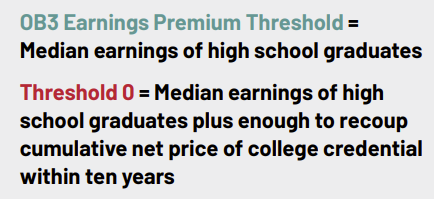
When Purpose Meets Payoff: How Program, Institution, and Field Shape Postsecondary Value explores this question and evaluates undergraduate programs’ postgraduate earnings outcomes by comparing them to two benchmarks. The first, the earnings premium threshold in OB3, requires average postgraduate earnings for all programs that receive federal loans to be higher than the earnings of a typical high school graduate. The second, the Postsecondary Value Commission’s Threshold 0, measures whether students are better off financially for having earned their credential, after accounting for the costs of college.
Understanding credentials beyond their earning potential offers a more complete view of their value. This report also investigates graduates’ access to and satisfaction with employer-provided benefits, such as work-life balance and job security, to better capture the full scope of postsecondary value.
How Do Program Outcomes Vary by Field and Institution?
Our dashboard allows you to explore the data in more depth, compare outcomes, and view how many programs are likely to deliver valuable returns.
How to Use the Dashboard:
- Depending on your screen size, you may need to zoom out using your browser settings or view the dashboard on Tableau Public.
- Use the Field filter to select a field(s).
- Adjust the selection under the Sub-Field filter to see outcomes for more specific fields.
- Select the breakdown of outcomes by institutional control and credential level.
- Adjust the Threshold filter to see pass rates for the OB3 earnings premium threshold (OB3) or Threshold 0 (T0).
- Adjust the Metrics filter to see the percentage of graduates whose programs pass the earnings thresholds or the percentage of programs that pass the thresholds.
- Hover over bars for details on counts of graduates, programs, and missing data.

What did we find and how should leaders respond?
Our analysis of approximately 40,000 undergraduate programs finds that 93 percent of programs, enrolling 88 percent of graduates nationwide, pass the OB3 earnings threshold. Under Threshold 0, which also accounts for the cost of college, 82 percent of programs, representing 87 percent of graduates, pass. The gap is particularly visible in fields that prepare students for essential public service careers. For instance, in Human Development and Family Studies, 97 percent of bachelor’s degree graduates attended OB3-passing programs, but only 58 percent attended programs that also met Threshold 0, a frequent pattern across early childhood education and social service fields. Certificate programs and for-profit institutions account for a disproportionate share of programs that fail the OB3 threshold.
Ensuring that a minimum earnings standard translates into real postsecondary value will require action from federal and state policymakers, institutional leaders, and employers alike:
- Support and incentivize strong outcomes for all students by enforcing minimum earnings standards across all programs, strengthening the education-to-career pipeline, and increasing wages and support for workers in high-purpose fields like teaching and social work.
- Invest in affordability to improve value by protecting and increasing federal Pell Grant funding, expanding state investment in public higher education, and growing institutional need-based aid.
- Improve data and promote transparency by passing the College Transparency Act, making program-level costs and outcomes data publicly available, and strengthening statewide longitudinal data systems.
Together, these steps would let students pursue careers that serve their communities without taking on unacceptable financial risk.
Data and Methodology Overview
The research draws on program-level data from the College Scorecard, along with data from the Integrated Postsecondary Education Data System (IPEDS) and the 2024 American Community Survey 5-Year Sample. To examine value beyond earnings, IHEP also analyzed data from the 2012/17 Beginning Postsecondary Students Longitudinal Study (BPS) and the 2016/20 Baccalaureate and Beyond Longitudinal Study (B&B). See Appendix: Methodology for more information.
Acknowledgements
We would like to thank the individuals who helped contribute to this report, including Mamie Voight, IHEP president & CEO; Erin Dunlop Velez, vice president of research; Diane Cheng, vice president of policy; Kelly Leon, vice president of communications & government affairs; Jocelyn Salguero, assistant director of policy; and Lauren Bell, communications manager.
All ideas, findings, and conclusions drawn by this brief are the sole responsibility of the authors.