How to Strengthen the Economic Value of Four-Year Degrees in South Carolina
Students who complete bachelor’s degrees from public four-year colleges earn substantially more than the typical high school graduate, even after accounting for the cost of their degrees. These increased earnings among young adult workers ages 25 to 34 in South Carolina add up to:
$ 965.6 Million Per Year
Higher education provides economic and noneconomic benefits to individuals and communities. The Postsecondary Value Commission’s Economic Value Contribution (EVC) framework measures the combined economic impact of student earnings by capturing the effects of access, affordability, completion, and workforce returns.
South Carolina’s Economic Value Contribution Formula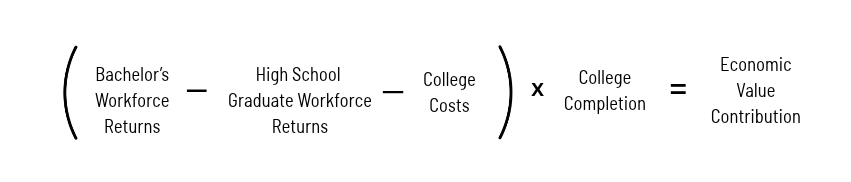
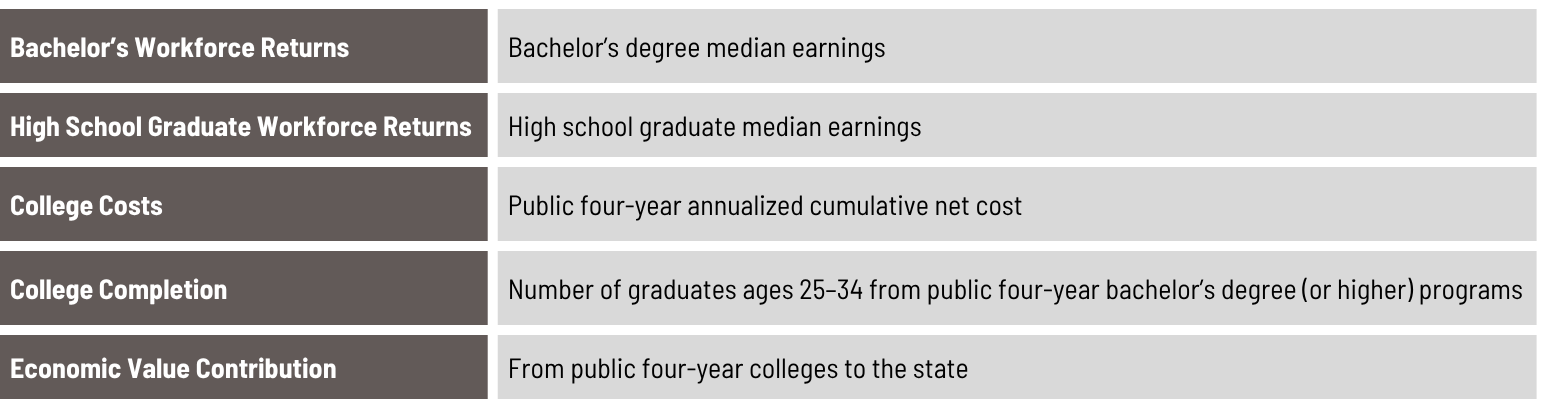
Definitions
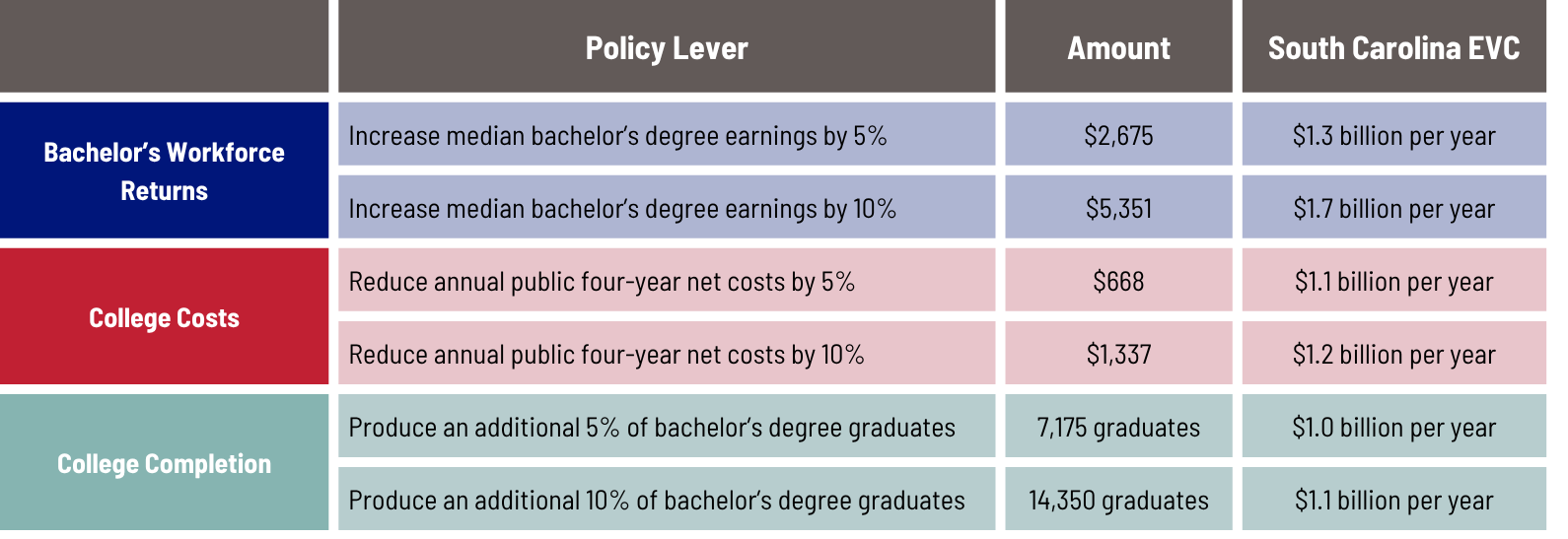
How Policy Changes Could Increase South Carolina’s Economic Value
Targeted policy changes across the EVC’s core components can improve student outcomes and strengthen higher education’s contribution to the national economy in three ways:
 Explore the data and learn more about the EVC methodology here.
How State Policymakers Can Strengthen Higher Education’s Economic Value for Students and the State Economy
Increase state investment and coordination
- Increase funding for public colleges. Help keep tuition costs low and invest in student success efforts. Public colleges enroll the vast majority of students.1
- Foster collaboration across state data systems. Enable agencies to establish data-sharing agreements that allow institutions to better identify gaps in student supports and services, coordinate public benefits eligibility such as Supplemental Nutrition Assistance Program (SNAP) and the Temporary Assistance for Needy Families (TANF) alongside other financial assistance, to improve student outcomes.2
Increase need-based financial aid
- Invest in free college programs. Prioritize first-dollar models over last-dollar models. First-dollar programs provide students with funding equivalent to full tuition and fees, allowing them to use other sources of grant aid for living expenses and other costs. Last-dollar programs cover the gap after all other financial aid and scholarships are applied. Free college programs should prioritize students from low-income backgrounds and avoid punitive eligibility requirements that can limit access.3
- Invest in state need-based financial aid. Increase need-based aid to help lower educational costs for students from low-income backgrounds and decrease their reliance on student loans.
Improve access to higher education
- Make the Free Application for Federal Student Aid (FAFSA) a high school graduation requirement. Use universal FAFSA policies, with an opt-out option, to promote college enrollment.4
- Streamline the application process. Use direct admissions policies, since research suggests that they increase students’ likelihood of applying to college, especially for first-generation students and students from low-income backgrounds.5 States can also incentivize partnerships and alignment between K–12 and higher education systems to smooth pathways to college.6
How Institutions and Systems Can Strengthen Higher Education’s Economic Value for Students and the State Economy
Improve access to higher education
- Reform admissions policies. Reduce barriers and expand access for students from all backgrounds by reevaluating the use of admissions tools such as demonstrated interest, standardized test scores, legacy preferences, and letters of recommendation. Prioritize practices that broaden opportunities for all students.7
- Reduce friction in the application process. Align admissions requirements with high school course offerings and eliminate early decision policies that can limit opportunities for students from low-income backgrounds.8
- Expand recruitment efforts. Recruit returning adults, community college transfer students, and rural students.9
- Offer flexible course scheduling. Help working students, adult learners, and parenting students balance college with other responsibilities by providing more accessible pathways to college.10
Increase college affordability
- Provide need-based financial aid. Close affordability gaps and improve persistence.
- Provide short-term emergency aid. Help students cover unexpected costs and prevent them from stopping out.11
Support timely completion
- Implement rigorously evaluated college completion strategies. Support programs that offer advising, financial assistance, academic and career support. They have been proven to increase graduation rates and increase wages for graduates. Examples include CUNY ASAP, InsideTrack, MAAPS, One Million Degrees, Project QUEST, and Stay the Course. Each has demonstrated positive impacts through randomized controlled trials.12
- Support student basic needs. Fund resources like on-campus food pantries and connect students to programs like the Supplemental Nutrition Assistance Program (SNAP) and the Temporary Assistance for Needy Families (TANF) program. These supports can help students stay enrolled and complete their programs.13
- Improve advising and wraparound services. Provide proactive advising and academic support, especially for first-generation students, which significantly improve persistence and completion rates.14
- Foster a positive, inclusive environment. Help support students’ sense of belonging, which is linked to higher retention and completion rates and improved academic outcomes.15 Promote student success by encouraging growth-mindset teaching practices, streamlining administrative processes, and reframing communications to normalize student challenges as part of the learning process.
- Reduce time to completion. Provide clear program pathways, proactive advising, and tighter program requirements to decrease the costs that students accrue.
- Establish clear, guaranteed transfer pathways. Reduce credit loss and time to degree.16
Strengthen education-to-career pathways
- Improve the education-to-career pipeline. Use data to ensure that programs are aligned with workforce needs. Provide robust career advising to students. Institutions should partner with local employers to identify the skills needed for career success and strengthen work-based learning opportunities, such as internships.17
Endnotes
1 National Center for Education Statistics, “Undergraduate Enrollment,” updated May 2023, https://nces.ed.gov/programs/coe/indicator/cha.
2 Kate Tromble, “Reimagining State Data Systems: Actionable Strategies from a Federal–State Conversation,” blog post, DQC, April 24, 2024, https://dataqualitycampaign.org/actionable-strategies-from-a-federal-state-conversation/.
3 Genevieve Garcia Kendrick and Kim Dancy, “Free College Programs in New Mexico and Arizona Can Help More Students Receive an Economic Return from Higher Education,” IHEP, January 9, 2024, https://www.ihep.org/free-college-programs-can-help-more-students-receive-an-economic-return/.
4 Sayda Martinez-Alvarado, A Scan of State Universal FAFSA Policies (EdTrust, February 2025), https://edtrust.org/rti/a-scan-of-state-universal-fafsa-policies/.
5 Lauren McLeese and Eleanor Eckerson Peters, “How Different Streamlined Admissions Models Shape the Student Experience,” IHEP, May 20, 2026, https://www.ihep.org/how-different-streamlined-admissions-models-shape-the-student-experience/.
6 Janiel Santos and Eleanor Eckerson Peters, A Snapshot of Postsecondary Access and Opportunity in California (IHEP, October 2025), https://www.ihep.org/publication/caadmissions/.
7 Karen Bussey, Kimberly Dancy, Alyse Gray Parker, Eleanor Eckerson Peters, and Mamie Voight, “The Most Important Door That Will Ever Open”: Realizing the Mission of Higher Education Through Equitable Admissions Policies (IHEP, June 2021), https://www.ihep.org/publication/mostimportantdoor/.
8 Karen Bussey, Kimberly Dancy, Alyse Gray Parker, Eleanor Eckerson Peters, and Mamie Voight, “Eliminating Early Decision Policies,” chap. 4 in “The Most Important Door That Will Ever Open”: Realizing the Mission of Higher Education Through Equitable Admissions Policies (IHEP, June 2021), https://www.ihep.org/wp-content/uploads/2021/06/IHEP_JOYCE_Ch3-1.pdf.
9 IHEP, “Rethinking Recruitment Policies,” https://www.ihep.org/wp-content/uploads/2021/06/IHEP_JOYCE_TOOL_RECRUITMENT_FINAL_WEB.pdf.
10 Ad Astra and Complete College America, Building a Healthy Culture for Academic Scheduling (Ad Astra and CCA, 2025), https://www.aais.com/resources-insights/report/rethinking-academic-scheduling-for-student-success-cca.
11 Carla Fletcher, Allyson Cornett, May Helena Plumb, Anthony Schuette, Lydia Mentzer, and Bryan Ashton, Student Financial Wellness Survey: Fall 2025 Results (Trellis Strategies, March 2026), https://www.trellisstrategies.org/research-studies/student-financial-wellness-survey-fall-2025/.
12 TICAS, “Comprehensive Approaches to Student Success Design Principles,” 2021, https://ticas.org/wp-content/uploads/2021/07/CASS-design-principles.pdf.
13 May Helena Plumb, Connecting College Students with Public Benefits Programs (Trellis Strategies, January 2024, https://www.trellisstrategies.org/wp-content/uploads/2024/03/Toolkit_PublicBenefitsPrograms.pdf.
14 Eleanor Eckerson Peters and Janiel Santos, “Supporting the Whole Student Through Holistic Advising: Reflections on ED’s Raise The Bar Summit,” IHEP, May 1, 2024, https://www.ihep.org/supporting-the-whole-student-through-holistic-advising/.
15 Eleanor Eckerson Peters, Madeline Rowe, and Lauren McLeese, How Student Experience and Belonging Interventions Can Support Strong Postsecondary Outcomes (IHEP, August 2024), https://www.ihep.org/publication/student-experience-and-belonging-strong-outcomes/.
16 IHEP, “How Strong Transfer Student Pathways Can Boost Enrollment, Advance Equity, Support Student Success,” press release, April 11, 2023, https://www.ihep.org/press/transferboost/.
17 Strada, “Work-Based Learning,” https://www.strada.org/focus-areas/work-based-learning.