
What the Education Department’s Reimagining IES report recommends for federal postsecondary data collections
Published Mar 04, 2026
On Friday, the U.S. Department of Education published a long-awaited report by former Senior Advisor Dr. Amber Northern entitled, “Reimagining the Institute of Education Sciences: A Strategy for Relevance and Renewal.” This report raises many important considerations for how IES data collections can better meet the needs of students, institutions, states, practitioners, researchers, and policymakers.
As leaders of the Postsecondary Data Collaborative (PostsecData)—a coalition of organizations committed to the use of high-quality data to improve college access and success for all students—we support the report’s call to ensure IES’s research and data are timely, relevant, and actionable, and that its infrastructure evolves alongside the needs of the field. But while thorough and well-reasoned, the report stops short of addressing critical reform areas including how IES can strengthen field engagement and renew staff capacity to do its vital work.
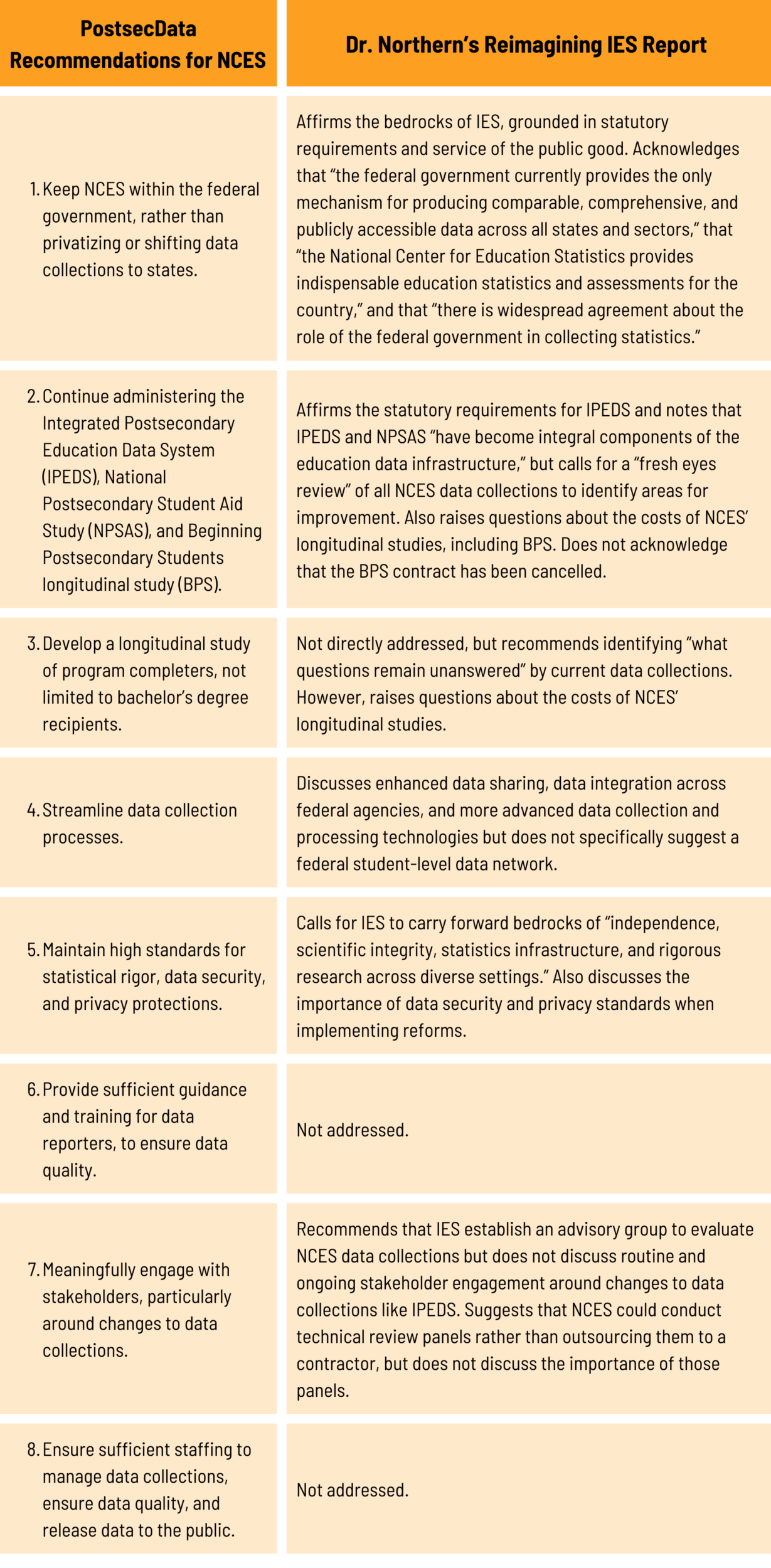
Dr. Northern’s report was informed by responses to the Education Department’s request for information about redesigning IES issued last fall. We led a coalition of 51 members and partners of PostsecData in sharing nine key recommendations for the postsecondary data collections administered by the National Center for Education Statistics (NCES), an independent statistical agency within IES.
Here’s how Dr. Northern’s report compares with our recommendations.
Reform recommendations require resources
Data collections led by IES help policymakers, institutions and evidence-driven researchers better understand how our country’s students access, afford, make progress toward, and derive value from a college degree or credential. Calls to modernize the division and strengthen the timeliness and utility of its vital work are not without merit. But reforms should not shortchange sufficient resources and data integrity.
To implement Dr. Northern’s recommendations, IES will need capacity. That includes statisticians and researchers who can steward the development, execution and rigorous quality checks that make federal education data so trusted. The report stops short of addressing IES staffing and resource levels—a notable omission.
Last March, cuts led by the Department of Government Efficiency reduced NCES staff from roughly 100 professionals to three, with recent hiring bringing the staffing only back up to 11 professionals today. In its latest federal funding package passed just weeks ago, Congress appropriated roughly $790 million to IES to support its vital work. That amount is on par with what the division received in prior funding years and reflects lawmakers’ commitment to fostering a strong education research and evidence base.
The funding package also notes the Education Department is required to, “support staffing levels necessary for IES and the National Center for Education Statistics to fulfill their statutory responsibilities.” Education Department leaders should keep these Congressional directives top of mind as they consider the report’s recommendations. We hope the agency approaches implementation in ways that strengthen—not diminish—IES’s role and capacity.
What’s next
In a blog post responding to Dr. Northern’s report, Acting Director of IES and Acting NCES Commissioner Dr. Matthew Soldner notes he will consider her recommendations, though no details nor timelines for implementation were shared.
We urge the Education Department to create opportunities to meaningfully engage institutions, states, researchers and other stakeholders who rely on IES insights to develop policies that support student success. Dr. Northern’s report recommends establishing an advisory group to review data collections. Members of the PostsecData community are experts in data use to support student success and stand ready to join that effort.
The PostsecData Collaborative will monitor the Education Department’s next steps following the release of Dr. Northern’s report. We will seek to inform any efforts to thoughtfully reimagine how IES does its work, especially its invaluable postsecondary data collections. A strong and agile federal education data and research infrastructure can support even stronger policies and outcomes for our nation’s students.