How to Strengthen the National Economic Value of Four-Year Degrees in the United States

Students who complete bachelor’s degrees from public four-year colleges earn substantially more than the typical high school graduate, even after accounting for the cost of their degrees. These increased earnings among young adult workers ages 25 to 34 in the United States add up to:
$140 Billion Per Year
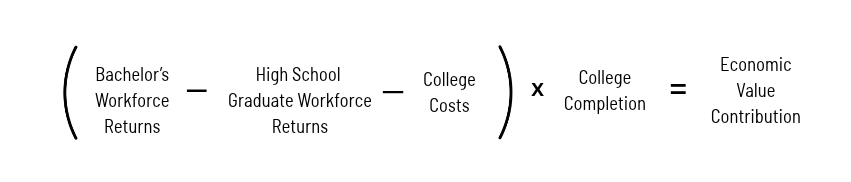
Higher education provides economic and noneconomic benefits to individuals and communities. The Postsecondary Value Commission’s Economic Value Contribution (EVC) framework measures the combined economic impact of student earnings by capturing the effects of access, affordability, completion, and workforce returns.
National Economic Value Contribution Formula
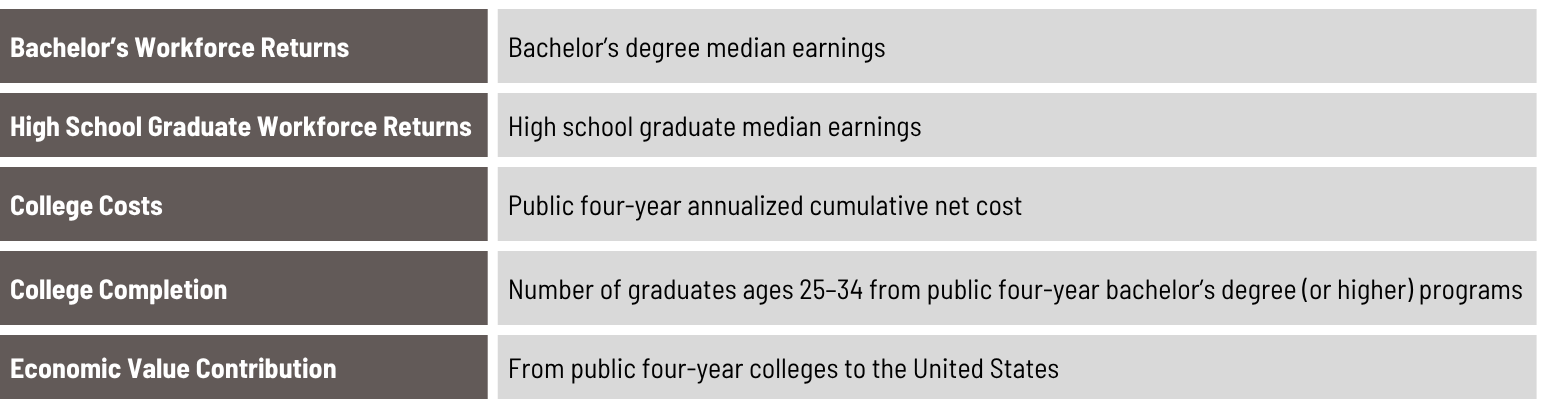
Definitions
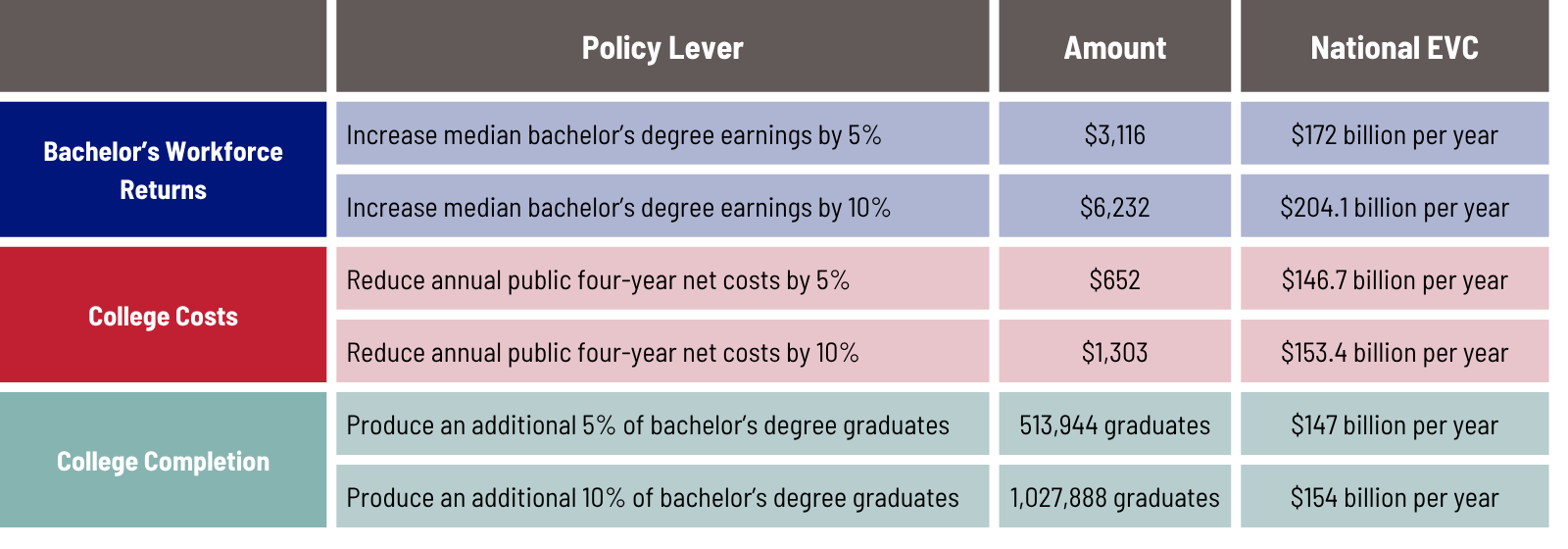
How Policy Changes Could Increase National Economic Value
Targeted policy changes across the EVC’s core components can improve student outcomes and strengthen higher education’s contribution to the national economy in three ways:
 Explore the data and learn more about the EVC methodology here.
How Federal Policymakers Can Strengthen Higher Education’s Economic Value for Students and the National Economy
Support college affordability, access, and completion
- Protect and increase the Federal Pell Grant. The Pell Grant is the cornerstone of our nation’s financial aid system, serving students with the greatest need. At its peak in 1975–76, the maximum Pell Grant amount covered more than three-quarters of the cost of attending a public four-year institution. In 2025–26, the maximum Pell amount only covers 24 percent of those costs.1 Congress should increase the maximum Pell Grant to restore its purchasing power and provide sufficient funding to support college access and affordability.
- Increase investments in the Postsecondary Student Success Grant (PSSG) program. The PSSG program helps colleges implement and expand evidence-based interventions to improve student retention and completion. Those strategies include advising, mentoring, tutoring, transfer support, and financial assistance for students from low-income backgrounds.2 Increasing PSSG funding would allow more colleges to provide support to students that help them stay enrolled, complete their credentials, and obtain skills to succeed in the workforce.
- Increase investments in the Basic Needs for Postsecondary Students Program. The Basic Needs program provides grants to colleges to support programs that address students’ basic food, housing, transportation, health, child care, and technology needs. This program helps students stay enrolled and complete their credentials.3
- Support funding for college access and success programs serving low-income and first-generation students. The Federal TRIO programs provide academic, financial, and other supports to first-generation students from low-income backgrounds to help them access and succeed in college.4 The Gaining Early Awareness and Readiness for Undergraduate Programs (GEAR UP) program provides funding to partnerships between K–12 schools, colleges, state agencies, and community organizations to improve college and career readiness for students from low-income backgrounds.5
Incentivize colleges to provide strong outcomes for all students
- Hold all programs accountable for meeting a minimum earnings test. While economic returns are just one dimension of postsecondary value, programs should not consistently leave students worse off than if they had never attended college. Holding all programs accountable to a minimum earnings threshold creates incentives for institutions to improve outcomes for their students.6
- Protect funding for minority-serving institutions. Dedicated, sustained funding across all MSI categories is essential to support institutions that are often under-resourced and offer broad-access admissions.7
- Support research and evaluation of practices that improve student outcomes. Colleges and states need help to identify and expand evidence-based practices, like those used by the Institute of Education Sciences (IES) programs,8 that improve student outcomes.
Provide data to inform student decisions about where to enroll
- Maintain the “low earnings indicator” on the FAFSA. Flag colleges where graduates, on average, do not earn more than typical high school graduates. This warning has led students to change the schools that will receive their FAFSA.9
- Strengthen student warnings. Students should receive clear warnings when programs fail to meet minimum earnings standards before enrolling, registering, making a financial commitment, or receiving federal financial aid.10
- Publish and continue collecting program-level data. Students need access to clear, comparable information on college program costs and outcomes,11 yet comprehensive program-level cost data remain unavailable.12
- Increase funding for the Statewide Longitudinal Data Systems (SLDS) Grant Program. More investment would enable states to modernize, integrate, and better connect existing data systems, strengthening their capacity to track student outcomes. By linking education and workforce data, states can use their SLDS to assess how well programs prepare students for success in the labor market and how well colleges meet workforce demands.13
Endnotes
1 The Institute for College Access & Success, “Make College More Accessible and Affordable,” February 27, 2026, https://ticas.org/wp-content/uploads/2026/02/Pell-Grant-Fact-Sheet_TICAS-2026-Federal-Policy-Agenda.pdf.
2 Joint Letter to the House Appropriations Subcommittee on Labor, Health and Human Services, on PSSG FY 2027 Appropriations, signed by 34 organizations, March 23, 2026, https://edtrust.org/wp-content/uploads/2026/03/Joint-Letter-PSSG-FY27-Approps.pdf.
3 The Hope Center for Student Basic Needs, letter to Shelley Moore Capito (chair, U.S. Senate Appropriations Subcommittee on Labor, Health and Human Services, Education, and Related Agencies), March 25, 2026, https://hope.temple.edu/sites/hope/files/media/document/FY27%20Basic%20Needs%20Appropriations%20Letter%20-%2025%20March%202026%20%281%29.pdf.
4 Council for Opportunity in Education, “COE and TRIO Programs,” https://coenet.org/coe-and-trio-programs/.
5 National Council for Community and Education Partnerships, “About GEAR UP,” https://www.edpartnerships.org/about-gear-up.
6 Diane Cheng, “New Accountability Framework Will Help Ensure Higher Education Provides Strong Outcomes for All Students,” IHEP, August 28, 2025, https://www.ihep.org/new-accountability-framework-will-help-ensure-higher-education-provides-strong-outcomes-for-all-students/.
7 Lorelle L. Espinosa, Robert Kelchen, and Morgan Taylor, Minority Serving Institutions as Engines of Upward Mobility (American Council on Education, 2018), https://www.acenet.edu/Documents/MSIs-as-Engines-of-Upward-Mobility.pdf.
8 AERA, “Turning Evidence into Impact: Why Education Research Matters for Every Learner, in Every Classroom,” n.d., https://www.aera.net/Newsroom/Turning-Evidence-into-Impact.
9 U.S. Department of Education, “U.S. Department of Education Celebrates More Than 10 Million FAFSA® Forms Complete and Additional Transparency Measures,” press release, March 26, 2026, https://www.ed.gov/about/news/press-release/us-department-of-education-celebrates-more-10-million-fafsar-forms-complete-and-additional-transparency-measures.
10 Diane Cheng, “New Accountability Framework,” IHEP, August 28, 2025, https://www.ihep.org/new-accountability-framework-will-help-ensure-higher-education-provides-strong-outcomes-for-all-students/.
11 Jocelyn Salguero and Diane Cheng, “Education Department’s Proposed Higher Ed Rule Includes Key Transparency Provisions for Students,” IHEP, February 11, 2026, https://www.ihep.org/education-departments-proposed-higher-ed-rule-includes-key-transparency-provisions-for-students/.
12 Institutions currently do not report program-level cost data for all of their programs to IPEDS. Only a subset of colleges report program-level cost data to IPEDS, and only for their six largest programs.
13 Data Quality Campaign, “What Are Statewide Longitudinal Data Systems?” July 2023, https://dataqualitycampaign.org/wp-content/uploads/2023/04/DQC-SLDS-fact-sheet.pdf.